Monday, August 1, 2011

How Do We Please the "American" God of Bike Helmet Compulsion?

From Capital Bikeshare in Washington D.C. Helmet imagery everywhere is bad enough, but showing bad fitting is pathetic (and I told them directly and indirectly many times about this photo).

Well, well, well...

You would think that they (Alta Bicycle Share, various govt. officials with the honourable and good intentions of implementing bike share, etc.) would have learned (a lesson in/their lesson in) Melbourne.

Capital Bikeshare in Washington D.C. is bad enough, seemingly not strictly requiring helmets but limiting liability of the operator if injuries are incurred by helmet-less users (helmets are not required under D.C. law for people old enough to use the bikes) See Section 26 of User Agreement in the previous link and their Safety Page. (This programme is partly funded by taxpayers; one wonders why people who ride collective public transport in D.C. do not have to sign a safety pledge about e.g. proper foot attire.)

Sadly, with the new bike share system in another USA right-coast city which opened last week, it gets worse.

NYC's bike share operator may be decided this month. Whoever the winner, given the high amount of helmet-wearing there, endorsement of helmets by Janette Sadik-Khan and Transportation Alternatives, and general victory of the "Everything is Good" Committee, I would not be surprised if the rules there also mandate helmets.

Draw a Line in the (left-coast Canadian) Sand against Helmetism at Velo-city Global 2012 in Vancouver!


Update - 9:44pm: @BrooklynSpoke Tweeted earlier this evening: "I don't think they will enforce helmet use. Seems like a way for Hubway to cover itself against litigious Americans." - This is clearly the case, but - as I mentioned above - why does collective PT not have the same conditions, and how about just using the pavement (sidewalk)? Compulsion is compulsion.

Thursday, July 14, 2011

Carmageddon!!!


In El Pueblo de Nuestra Señora la Reina de los Ángeles del Río de Porciúncula this upcoming weekend is something filling the brains of USA drivers (and their dependants) - with the possible exception of some New Yorkers and San Franciscans - with total horror but which I hope is making many others around the world laugh out loud: Carmageddon!


A three-day closure of an important rubber-tyred road vehicle link in Los Angeles. Sigh. I am from the West San Fernando Valley (what was once Owensmouth, then Canoga Park and now West Hills) and from before birth until around age 17 was driven over the hill - along with my older brother - between the Valley and West L.A. thousands of times.


First from my house to the maternal grandparents or the paternal grandma, then also to my dad's after the divorce, then - after a move - from my dad's to where my mom later moved closer to the Sepulveda Pass, which is what the San Diego "Freeway" - or 405 - goes through between these two main parts of L.A..


This was the real horror. Back and forth. Back and forth. Back and forth. My mother would come pick us up or my dad would drop us off almost every weekend. This is not quality time. Sitting. Sitting. Sitting. Stuck in traffic. Ugly. Ugliness. 


How nice it would have been to go by public transportation. If I remember correctly, my father told me remembers seeing a L.A. streetcar arrive from the Valley with snow on its roof in the pre-Freeway days, must have in the late 1940's.

http://sbb.filepool.ch

Yes... wonderful to do something a bit more constructive than sit strapped up over the years on the red vinyl seats of my mom's Volvo, the gray fabric seats of my father's Volvo, the synthetic something or other seats of my mom's Oldsmobile, and some VW's, a Ford, a Chevy plus whatever my grandfather drove.

http://sbb.filepool.ch

The great news is that after this final stage of construction the new regional railway vehicles over the Pass will have playrooms for children, similar to above. 

And then I woke up to reality.

Sunday, June 19, 2011

SkirtGate & What happens at a Cycle Chic Bloggers' Conference?


Last things first. This guy seemed to have written that it was invite-only, but that was probably just cheekiness and then I DID receive a Facebook invite from a Catalonian. I did not go and am wondering what happened. We should know soon enough through the regular channels but here are my guesses:

* Building on their Manifesto, deciding punishments for activities such as illegal use of the trademarked Cycle Chic name and typeface;
* Teaching newbie Cycle Chiclets and the male version, Chucklets, about why identifying as a "cyclist" is a no-no but proclaiming that one is a "citizen cyclist" should be encouraged;
* Deciding on the minimum-quality body suitable for pixelation;
* Establishing rules on only photographing women on bikes from behind.

I am sure the story of Jasmijn Rijcken - the short-skirted Dutch woman on a bike stopped by a cop in NYC - came up repeatedly.  As various people from this non-sub-culture proclaimed this


          "Puritanism", and, more specifically....


... called the cop "Taliban-esque", I would guess that they are planning a short-skirt flash mob Citizen Cyclist tour in villages in the mountains of Afghanistan and Pakistan. Or indeed in Saudi Arabia. I wish them luck with that.

But seriously....

In a follow-up to the Streetsblog entry mentioning Saudi Arabia, there is a discussion of this was a hoax or not -- some kind of viral marketing. In this entry Noah Kazis concludes that there is not, but others - sorry, no reference for it - think it is. Perhaps the truth lies somewhere in between: Rijcken was cycling innocently as pictured, did get harassed by some primitive, sexist police officer and then only later on did she and colleagues decide to make the most out of it.

There are plenty of difficult barriers for women to do any kind of cycling, and fashion - whether individual, or branded, globalized and trademarked - should not be another one. Cycle Chic (TM) and cycle chic are both great and fun, but my suggestion for the people involved in e.g. a related solidarity ride is to not just look in the mirror, but consider more good ways to use their wheeled, sartorial power to re-clothe the actual city streets in a fashion that directly addresses the needs of all women, or everyone.

Wednesday, May 11, 2011

The Ultimate Bike Helmet-related Letter to the Editor


OK, just kidding (sort of). The May/June 2011 Momentum magazine features "The Helmet Debate" by Elly Blue (four pages long), as well as two bike helmet buying guides, a separate short helmet review, a full-page helmet ad, a contest with a helmet as a prize, lots of nice photos of both helmeted and unhelmeted cyclists and also several letters regarding helmets, which were submitted in response to a request in the March/April issue. They printed/posted a short letter of mine. Following is the longer version from which it was excerpted (I sent it at the end of March and tonight I added some additional paragraphs).

Dear Editor,

Very detailed information related to your question of mandatory cycling helmets has been done by the Bicycle Helmet Research Foundation. Beyond that, I am quite interested in the imagery of helmetism, i.e. how promotion and compulsion of cycling helmets are, perhaps, closer cousins then we think:

To start, nearly all urban cycling promotion organizations suggest that helmets are safer and implying or explicitly state that you are smart to wear one. This includes both the San Francisco Bicycle Coalition and Transportation Alternatives (NYC), the latter with their Biking Rules project, which irritatingly conflates their recommendations of helmets with laws for cycling. An exception is C.I.C.L.E, from Los Angeles, which had what I would call a very pro-choice helmets page, with simple, objective information and links (including to the Bicycle Helmet Research Foundation). (Just added: That link is dead now, the C.I.C.L.E. website is in the midst of a re-design and the only new helmet link is typical of most other bike orgs. Will update if it changes back. Sigh).

Consider that most of the other local organization's publications and websites have helmet imagery which might support the view of the organization which created the page but often does not reflect the real helmet-wearing rate in their area and this is worse if the photos are more general, i.e. of how cycling looks in the city they work in.

I believe a good solution for that would be to determine roughly what helmet-wearing rates are and pick and commission photos of helmeted and unhelmeted cyclists to accurately reflect that.

Beyond that, cyclist pictograms in e.g. bike lanes in USA cities without mandatory helmet laws have helmets! As an illustration of a consistent approach to compulsion via promotional bombardment: Washington D.C.'s Capital Bikeshare website has a cyclist with a poorly-adjusted and thus useless helmet. And this from the company which runs that scheme. And that company's president. (I like much of what Alta does but just want to make a point about how helmet promotion can be both directly and indirectly connected with various initiatives.)


Added tonight: Capital Bikeshare sounds successful from all reports I have seen, however I am curious if all members have read the fine print in the contract, which requires them to sign a safety pledge (i.e. to agree to abide by recommendations on the safety page of the website, which of course includes wearing a helmet.) In addition, the contract says that Alta Bikeshare is "...not liable for any claim including those that arise from or relate to [...] failure to wear a bicycle helmet while using a Capital Bikeshare bicycle...".

What I find most troubling with all this is that while Washington D.C.'s helmet law only applies to children under age 16, users of Capital Bikeshare have to be 16 or over. The system is funded in part by taxpayers through Federal and local funds and because of this and also its design function it's a form of public transport. So while the D.C. government does not require helmet-wearing for people eligible to use Capital Bikeshare users via its democratically-created laws, it does require it via membership contracts for this system which it supports financially.

Perhaps someone with better legal knowledge can enlighten me about why there is not something peculiar about this.

On the other hand, B-Cycle - and I mention them because at this moment they and Alta Bikeshare are finalists in getting the NYC bike share gig - makes no mention of helmets in their membership page (at least in this one for Denver -- there is no statewide helmet law in Colorado for anyone). But to be fair to Alta, I assume there are other contracts in the USA which are similar to theirs, though I do know they will be doing something similar with their new operation in Boston.


At some point formal helmet compulsion becomes unnecessary when there is a never-ending barage of helmet imagery. (I am arguing that it does not matter if an org. which strongly promotes helmets say that they are also against laws to mandate it.) If people only see helmeted cyclists, they might not even ask if it is required to wear them or not. They will just assume so. I know that recently in NYC a police officer gave a ticket to an adult cyclist for not wearing a helmet, when actually there is no requirement to wear one, unless the cyclist is doing commercial activity. That is how crazy this gets. It might also be useful to compare how even a majority of opinions against mandatory cycling helmets in response to your query can compete against not just helmet company advertisements in Momentum, but all the other likely ads which have helmeted cyclists in them.

Finally, consider something else: If a serving politician promoted driving helmets they would be voted out of office (If they were running for election they would never win). Another: This is an issue of personal freedom, since helmet wearing - or not - only affects its user, and parents should be able to decide this for their children for the same reason. And one more: Required labels inside helmets do not clearly state under what kinds of crashes are simulated in helmet testing and their marketing is even less precise. I have a suggestion for this.

My accepted abstract for the last Velo-city in Seville, Spain, "Helmetism & Hyper-illumination" provides further information and references. I have a Facebook Page on the subject focused on Velo-city in Vancouver next year.

Kind regards,
Todd Edelman
Green Idea Factory
Berlin, Germany

Decade of Action for Road Safety: We are all "Steve"?


Today starts the "Decade of Action for Road Safety 2011-2020", a collaboration between the World Health Organization (WHO) and other partners. The "Wear. Believe. Act" website, which is the official page of the campaign, is hosted by the FIA Foundation, which also supports the campaign's "Road Safety Fund". The Road Safety Fund - a legally distinct UK charity - is co-chaired by the Director General of the FIA Foundation (FIAf - the reason for the little "f" will become self-evident shortly). Confused? Well, anyway, before I mention the graphic above, I will explain why I have not included a link to FIAf: This is because none of the pages above link to FIAf, or - I really did look around - describe what it is.

FIAf "... established in 2001 with a donation of $300 million made by the Fédération Internationale de l'Automobile (FIA), the non-profit federation of motoring organisations and the governing body of world motor sport..." which came from - "well, finally!", you might be thinking - this link.

This partial obfuscation - intentional or not - on the rather professionally-done "Wear. Believe. Act" website - oh, and by the way the first WHO website mentioned above is supported by the World Bank - is consistent with the video which is the source of the graphic above.

The video is produced by the International Federation of Red Cross and Red Crescent Societies' (IFRC) Global Road Safety Partnership (GRSP), another partner of WHO. (The link to IFRC on the "Wear..." links page is dead), in support of the launch of the Decade of Action.


The video "...aims to give the viewers a different perspective on road safety by focusing on the hidden danger on the roads...". It is worth noting, first and foremost, that the video makes clear in gross terms that there are over 1.3 million annual road deaths, a statistic many carfree campaigners started to spread years ago.

So, when I first watched this I was pleased that that was mentioned (and it is included on the "Wear..." website, if less prominently).

The problem then is that the video goes completely and ridiculously overboard in two ways, the first I describe might not be intentional but the second definitely is.

Firstly, the reaction of fellow blogger David Hembrow to the video was "WTF was that all about ? All I know is that I'm now very very scared indeed, and am wondering if a Hummer would maximize my safety on the streets. I think they somewhat missed the point of their own message - i.e. that cars kill the majority of those 1.3 million people per year." This is so overwhelming it could just get people to turn off (and indeed the video suggests no solutions, just a link to the campaign website). In any case, this provides a segue to the second point, which is that the video says "we" created this system, and thus that we are all "Steve" (the sole character in the video, in multiple roles).

This is of course rabidly irresponsible, and - as my blogger friend says - misses the point about cars. By homogenizing responsibility, the message totally overlooks the fact the majority of victims are poor and in the Global South, the majority of beneficiaries in terms of ownership of companies is in the North, most people in the Global South do not have cars and are rarely in cars, that children cannot vote in elections and of course that a great many people in the Global South do note vote in free and fair elections (the last two points showing how creation of the system has been anything but democratic).

Now, back to the "Decade of Action..." - in the end of the video you will see that Youth for Road Safety (YOURS) is another partner (and they are supported financially from the get-go by Michelin).

The campaign mentions nothing - at least I could not find anything obvious on the website which is as far as the average person will go - about emissions or other direct or indirect effects of automobile dependency, from obesity to urban sprawl. Emissions is something that WHO deals with, as in obesity, so why are things not mentioned in the goals of the "Decade of Action..."?

In this clip, from BBC4 radio, the interviewer does her best with a good intervention with Lord Robertson, chairman of the Decade of Action for Road Safety, but at the end an essential fact is not joined up. (Robertson does everything to avoid it, a truly shameful and ultimately murderous act of deceit.) Can you hear what is missing?

That interview includes words by Ian Roberts, who paper published in the Journal of the Royal Society of Medicine in 2007 writing about the establishment of the GRSP - questions if Formula One racing (as a symbol, but it is also the raison d'être of FIA) can really be responsible for public health and proposes that "...it is time to establish a truly independent Commission for Global Road Safety that will put the daily toll of 3,000 road deaths before any commercial concerns."

***

Related:

A 2009 article in the Road Danger Reduction Forum, based in the UK, serves as a good introduction to John Adams's fine work on seatbelts. The RDRF also today issued a press release about the launch of the "Decade..." (apparently Formula One race drivers are visiting 10 Downing St.)

Amend, based in NYC, supported by the FIA Foundation and with programmes in Ghana and Tanzania, has a poster for its "See and Be Seen" initiative:

(click on image to enlarge)

On the other hand, children in many cities in the North (and NYC) are now being told to play in the road, albeit a road calmed by various methods or philosophies. Do children in the Global South deserve less? Of course not... so do Amend and similar orgs. think that this "Don't play in the street!" warning from 1960's to 1990's era mothers (and fathers) is somehow the most relevant communication, i.e. enshrining - for a time - countries in Africa and elsewhere to this stage in transport development? Once automobilization gets established is it really hard to eradicate, as we in the North know so well, so why don't we help the Global South leapfrog to the next stage? (If FIA was supporing anti-malaria programmes there would be posters telling children to seal themselves in plastic bags.)

Thursday, March 24, 2011

Seville: "Great is the enemy of good"

The People for Bikes website has a nice, short article about the recent very rapid increase in cycling mode share in Seville, Andalusia (Spain), location of the Velo-city cycling conference which ends tomorrow. The separated cycling infrastructure - Seville was awarded the UN Habitat Best Practice Award for it's creation - was cited as the main reason for this.

The bike mode share is about 7%. What is the breakdown regarding gender, age and income level?

I am also curious about this excerpt:

“Great is the enemy of good.” The city’s infrastructure emphasizes network connectivity, not perfection. It’s far from the polished bikeways of Northern Europe, but the protected bikeways of Seville are safe, convenient and get you where you need to go without interruption

First of all, I am happy to find out that most bike space was taken from car space.

But I don't understand how bike space taken from pedestrian space can be compensated elsewhere. After all, it's not like carbon and e.g. trees -- and how do pedestrians move in these spaces after losing space? Of course it is just political.

What is the lack of "perfection"? I would guess that the writer from People for Bikes was referring to what a Catalonian mobility consultant told me about: The two-way paths such as the one in the photo above - and this seems to be the most common design - which are narrow (two wider cargo/child-carrying bikes passing would need to veer into other space if available and of course if people are allowed to/want to ride side-by-side it is dangerous and/or illegal and one would constantly need to accelerate in front of or drop behind their travel partner.) 

Certainly this lack of perfection - and conditions are certainly not perfect in many Northern European towns or even the best of them - is less important if unwarranted by the great but still low 7% mode share - but what if demand increases further? Will there be enough pressure to, for example, make double lanes single and a counterpart added to the other side of the street? The example photo in the linked article has a two-way on a one-way street which looks a 3- or 4-lane motorized traffic canal with parking removed on one side for the bike stuff.

And regarding "without interruption" I would like to see an example of major crossroads. Hopefully some colleagues and others who are there can fill us in.

Last but certainly not least, do the citizens of Seville deserve less than people in Amsterdam, Copenhagen etc. ? Certainly not, and regarding budgets and politics the very important question that needs to be made is if infrastructure for motor vehicles is just as far from perfection there.

From what I have read and heard there are other things which help make Seville great. It is certainly always a bit nicer to cycle in the sunshine with a good meal of fresh food at the end of your journey.

Rita Hayworth's father is from Seville (from Rides a Bike).

Wednesday, March 23, 2011

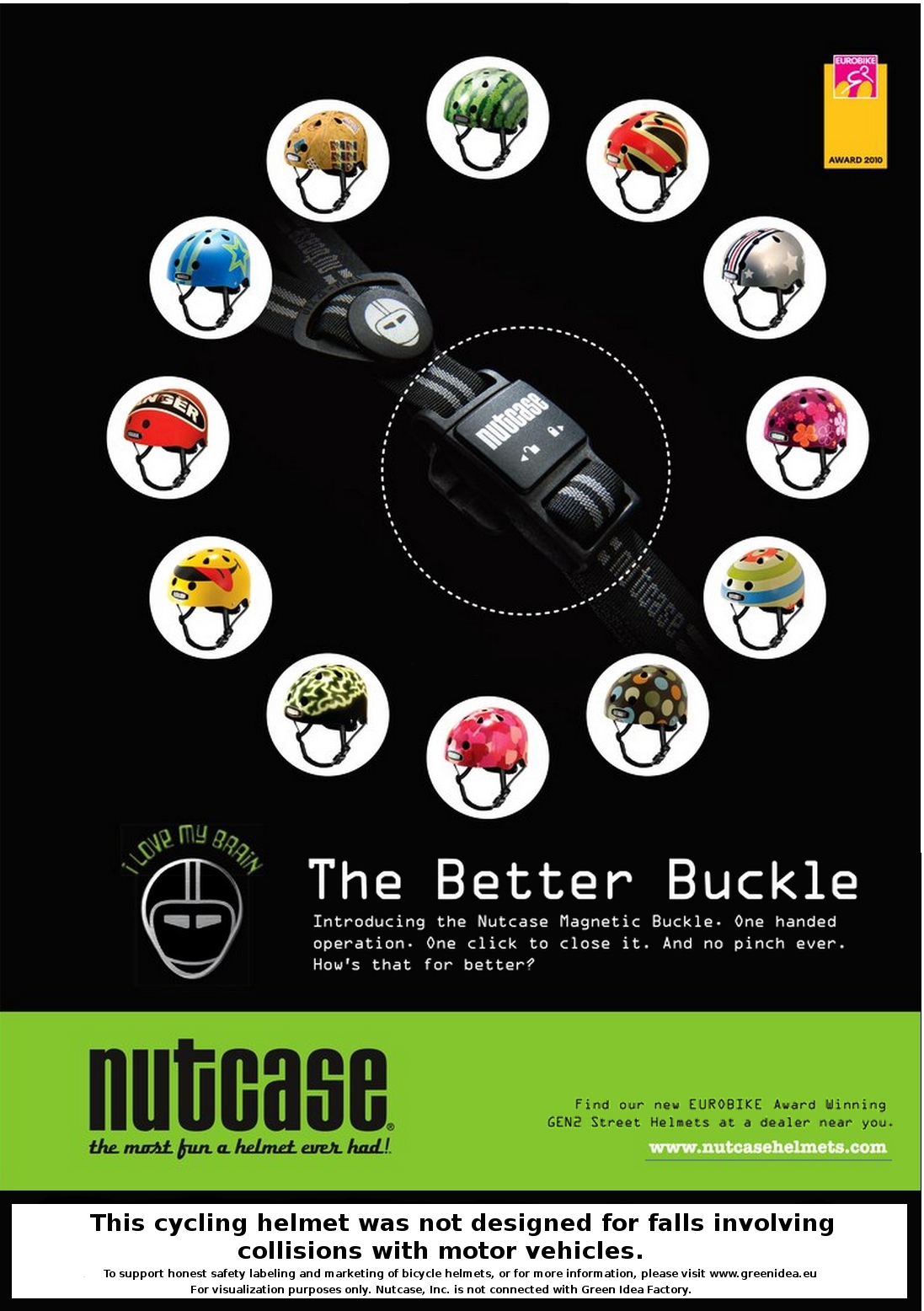
Don't we want honest labeling on bicycle helmets?

(Please click on image for full effect. The original advertisement is used for visualization purposes only. Nutcase, Inc. is not connected with Green Idea Factory.)

Bike helmets are getting more colourful these days. Perhaps they are also better designed, but the fact remains that they are not designed for typical crashes between a cyclist and a motor vehicle, when the latter is operating at typical speeds (above 30 km/h or 20 mph). They are tested to simulate a cyclist falling without the involvement of a motor vehicle, and very slowly, at less than 15 mph.

I would bet, however, than most bike helmet users do think they are tested and make a big difference in a crash with a car. It is clear that helmet producers are not interested in pro-actively communicating information about this design limitation to their customers.

I am pro-choice on helmets, for helmet freedom, and if wearing a helmet gets you on a bike that's great, but correct information is just as important as subjective safety.

If you are interested in helping research what helmet users really think, and pressuring the helmet producers to help create more honest labeling and marketing, please comment here or write me at edelman(at)greenidea.eu.

***

For more information on bicycle helmets see the website of the Bicycle Helmet Research Foundation.

To join the Facebook (Fan) Page "No Mandatory Bike Helmets at Velo-city Global 2012 in Vancouver" click here.

You are free to download this image, print and distribute. You may also download a smaller PDF (should print okay in A4 or 8.5 x 11 with white borders) at this link.


Wednesday, December 8, 2010

Non-profit pro-helmet group in Canada sponsored by automobile producer


In September 2010 Prohab organised some kind of helmet-themed art show, and in a subsequent entry in their blog they thanked this sponsor for their support of the show.

In a related video, the (presumably) staff of Profab pilot "borrowed" samples of sponsor's product in order to show how they could avoid obstacles in a modern city.

p.s. Also related.

***

Join "No Mandatory Helmets at Velo-city Global 2012 in Vancouver" on Facebook.

Monday, November 22, 2010

The Conditional Surrender

 Traffic congestion in the Dutch capital, including a Prius and a bunch of brand new cars. From The Hamperium.

A video from Mark Wagenbuur in the latest post at Copenhagenize is an extremely dangerous (way to talk about) history. Please watch it before proceeding.

First of all, in response to Mikael Colville-Andersen's brief comment, a comparison of the situation which "vehicular cyclists" deal with (and perhaps enable to some extent) with that in the Netherlands leaves out at least one alternative...

I love what Mark Wagenbuur does. Many videos on his You Tube Channel are also on the excellent A View From the Cycle Path (this a direct link to a post with another great Wagenbuur video), often accompanied by interesting comments.

The not-recent history of surface transport in the Netherlands is mostly new to me (and I appreciate this very much). The problem in the story starts with railways, which - relatively-speaking - introduce a kind of precursor to or early-stage hypermobility to the country. Trains, like trams, increased the distances between destinations, making speed necessary to compete, and thus addictive. But until various decades in the first half of the 20th century this still kept cycling popular and/or dominant.

The fatal error came - as the video shows, but with a different take on it - when cities introduced a design style from the countryside. It seems that this was not seen as a fatal error by enough people at the time: Either there were three options in the cities (i.e. keep streets the way they are OR separation for cyclists OR keep the motorized vehicles out) or just the first two. The video does not make clear exactly who made the decision. Were people predicting the situation about 50 years later in the 1960's (my understanding is that this was the nadir of cycling in the NL as well as in Denmark)? If so, were their voices ignored? If there were not many voices - and so not three choices - it is fair to say that this was bad and wrong, but we must also appreciate everything which has been done to fight back (very much including the new design elements in the video which I provide the link to in the Hembrow blog).

So, these days, when at its best cycling modal share is about 50% (as it is Groningen in the north of NL) and innermost parts of Amsterdam, Copenhagen etc.) is the glass half-full or half-empty? This beverage also contains collective public transport (nearly and chronically ignored in some cycle-cheerleading), but what if the non-PT and walking split is half private automobiles and half bicycles? Should we be half-happy or half-sad? (re: cheerleading, notice how that story does not mention collective PT?) It depends on who is writing or showing the history, yes? Indeed, could the private automobile lobby show a video on their You Tube channel, boasting about how they have managed to hold on to a huge modal share despite all the traffic jams, parking costs, "green" and health issues?

Cycling in the Netherlands is great - safer, etc. than here in Germany, where the separation model has been used often at the expensive of pedestrians - but I don't think it is accurate to say that the bicycle has "won" there (as someone told me recently). It is more truthful - and more objective - to say that the car has had a (very) conditional surrender (I am reminded also of something my father told me: During WWII - my Slovak father was a tween/teen at the time - the German radio referred to everything post-Stalingrad as a "strategic withdrawal").

Still, there is news which we can agree is good and which deserves strong praise: The bikes move faster than motor vehicles much of the time on separated paths in cities when the motorised lanes are congested, so actually these paths can more positively be called "mobility express lanes" (not just "bicycle highways")! But at the same time there are still a very high number of people trapped in their cars, and they are not the only ones who are suffering. Noise and gas/particle emissions still exceed allowed limits in parts of the Netherlands (and Denmark, and of course in many other European countries), and this hurts everyone.

Looking back over 100 years it is perhaps easy to condemn a decision, or how it was made, or indeed if anyone cared, but allowing (especially private) motor vehicles (which kill on contact at only half of their design speed) inside cities was a mistake, and is proving a very, very difficult one to correct.

Thursday, November 4, 2010

Melbourne Bike Share: Helmet dispensers, but no one to help adjust fit


Are 7-Eleven employees in Melbourne trained to fit bike helmets?

The State of Victoria, Australia, requires all cyclists to wear helmets. This reduces the chance to use Melbourne Bike Share spontaneously, a problem its operators are trying to solve by making helmets available near this 3rd Generation system's docking stations.

As I saw on the Bike-sharing Blog, 7-Elevens in Melbourne now have bicycle helmet dispensers. It is well-known that helmets have to fit properly with straps adjusted in order to fulfil levels of protection promoted by helmet advocates. The Melbourne Bike Share website - copying regulations for the State of Victoria - says:

"Bike Helmets - The rider of a bicycle must wear an approved bicycle helmet securely fitted and fastened on their head."

"Securely fitted" seems to very clearly mean expertise is needed, either from personal experience, or from an experienced friend, or of course (as the default) from the staff in the establishment selling the helmet*.


I found nothing on the Melbourne Bike Share website to indicate that any help is available from 7-Eleven staff. The vending machine (see photo) has clearly indicated large and medium sizes (perhaps the small size is hiding) and some text with the title "How to Ensure a Proper Fit", but without graphics. 7-Eleven issued a press release on 13 October which seems to indicate a lack of understanding of the importance of helmet fit:

“7-Eleven makes every effort to stock what you want, where and when you want it. Just as you might pick up your bottle of water, sunscreen and snacks for your picnic, now you can pick up a helmet for a bike ride along some of Melbourne’s scenic parks.” - from Julie Laycock, 7-Eleven Head of Marketing.


Click to enlarge the photo, which is from Capital Bikeshare in Washington, D.C. I am not certain if everyone involved understands how helmets are supposed to fit. (Where do all these cyclists in the photos on the website keep their helmets or is this wishful thinking?).

A poor-fitting helmet can increase injury even more than other inherent design faults of a bicycle helmet (such as rotational issues, often discussed in helmut forums). So if a poorly-fitting helmet increases the injuries to a Melbourne Bike Share user, who is liable? Who is responsible?

Also, it is my understanding that when not being worn a helmet is vulnerable (e.g. just hanging on a backpack) as it is designed to have strength in aggregate with a skull. Perhaps this can be explained in an analogy of a large ship in water, and what happens if it a large part of it leaves the water. I may be wrong about this.

If anyone can provide some answers or thoughts it would be appreciated.

- T

*Certainly, mail order helmets can create the same issues, and of course mail order can also create problems in bike fit which can terminate an interest in cycling... but as we all know the bicycle manufacturers in general prioritize selling stuff over creating more cycling.

** If you're on Facebook, please considering joining a related initiative.

Wednesday, October 20, 2010

The Amazing and Fashionable Airbag Bike Helmet


OK. This is so terrible that we should waste as little time as possible on it. A crew from Malmö, Sweden at the design firm Hövding has created what Treehugger calls an "airbag for your head". It normally sits around your neck as a huge, stupid, puffy, totally impractical collar. See also Bike Snob's take on it, this and David Report.


Is there some international police force, Interpol, etc., someone at the UN who can go make a visit - here is their address - and arrest them for this total garbage? A citizen's arrest, even? OK, like I said, can't take more time with this... thanks for your cooperation.


See more on bicycle helmets here. I am pro-choice on helmets, and generally refer to the position of the great CICLE from Los Angeles - my home town! - on this subject.


** If you're on Facebook, please considering joining a related initiative.

Sunday, September 12, 2010

Lux-Narcissism (Was: "Don't Believe the Hype-rillumination")


Cycling is generally very safe.

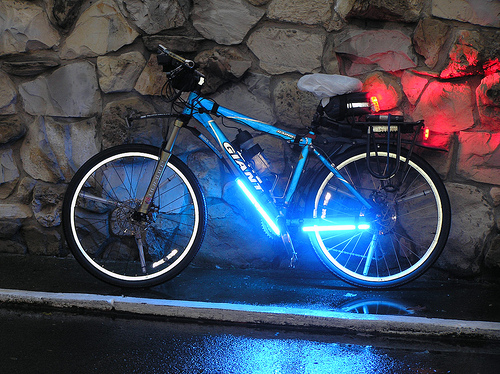
For celebrations on a "bike theme" or not, certain special events etc. the MonkeyLectric Bike Wheel Light is lovely and wonderful, but it represents an extreme version of what I call "Hyper-illumination" creating both acute (at the moment of use) and chronic (cultural) danger for other vulnerable road users (VRU's, both pedestrians and cyclists), even those - only in the case of cyclists, of course - who are legally illuminated.


Less extreme Hyper-illumination includes reflective vests (which should only be worn by emergency or construction workers or related), reflective jackets, an excessive number of normal lights or reflectors, projections of bike paths around cyclists, or even "bright clothing at night" which many authorities and organizations recommend, also for pedestrians.


Fundamentalist hyper-illumination is exemplified by having the stoker on a tandem carry a torch or flare gun, or getting the air force or army to clear your path with napalm or phosphorous.

Acute Hyper-illumination means visually-obscuring other VRU's in immediate proximity, in other words making the eyes of drivers of motor vehicles adjust to the brightest thing, which means they can't see the darker stuff (and pedestrians can wear all the black they want).

Chronic Hyper-illumination is obscuring over time and in relation to place, i.e. it relates to learned behaviour. This means that when a driver becomes accustomed to a lot of VRU's being hyper-illuminated, they will not look for normally-illuminated VRU's elsewhere.

Something both Acute and Chronic relates more to cyclist-pedestrian interactions: A cyclist with no lights and only some passive hyper-illumination device such as a reflective vest may think that they are visible to pedestrians, but they are generally not more than normally because their vest is designed with car headlights in mind.

If you agree with me on this take on things I hope you also agree that its use for commercial advertising purposes should be illegal, or least very expensive. I would not go as far to say they should be illegal for non-commercial use at any time, but this is only because bikes should just be as close as possible to wheels attached to your feet, with things like "rider's licenses" never necessary.


There are slightly less extreme hyper-illumination devices than the MonkeyLectric, such as The Down Low Glow (and I really like other Fossil Fool inventions) which to its credit seems to intentionally exclude the "unique advertising opportunity" thing. This website mentions "...cyclists feel safer..." and subjective safety is important as long as it is not at least out of balance with objective safety. It would be good to know if The Down Low actually makes things safer compared with bikes with typical, legal lighting.

These things could be useful for community police bikes, ambulance bikes or perhaps - if modified to be tamper-proof - as part of a theft-deterrent/triggered visible alarm feature. Even if they are fun (and obviously people have to purchase and install them) they distract from efforts for the promotion and implementation measures which make travel safer for ALL vulnerable road users: Slower speeds, less cars or obviously no cars, default liability for drivers and perhaps making cars softer (unless it causes risk compensation such as anti-lock brakes).

I would also be curious if cars tend to be driven closer to Hyper-illuminated VRU's.

Interestingly, the MonkeyLectric has dealers in many places, also in Europe. But not in the Netherlands, the safest place to ride in Europe (not perfect, to be very clear. No one should ever let the Dutch slack). Coincidence? Well, at this point the typical response is "... when our city is as safe as Amsterdam we will not need this stuff...". So the question is does having this stuff really move things forward towards an Amsterdam (or Dutch) level of safety?

I think the answer is no.

Updates:
* Another related attempt at a solution here, a backpack with turning and other signals. That the signals are not quite standardized might not be an issue, but having HUGE removable lighting certainly is! When it comes to normal city cycling, fixed front and rear (hub) generator lights, basic reflectors and proper turn signals with eye contact are really all that is necessary, right?)

* Continuing on in this Fall of Fear, this Autumn of Angst, see the continued rash of useless garbage cruising for a landfill in Treehugger.

* Bike Snob calls the video "Let's Get Visible" by Momentum magazine and partners the "worst PSA" he has ever seen. It features products from MonkeyLectric and Lazer helmets. See it here on "No Mandatory Helmets at Velo-city Global 2012 in Vancouver" on Facebook.
* I also recently had an exchange with FIAB (the Italian Cyclist's Federation) about this issue. They promoted hi-viz vests (tunics, really) starting early this year and I question the connection to the more recently implemented national law in Italy requiring the wearing of vests outside of urban areas and in tunnels (France and Hungary have a similar law. The European Commission has a guide to helmet and vest laws in member states, but some of the information regarding helmets is incorrect).
* In November the UK Guardian ran an article about bike lighting. The comments are full of dozens of guys shamelessly comparing the size of their lumens.


http://www.elevengear.com/trafficmaster.html

Thanks to Workcycles for showing me the light.

Related (26 April 2011): London cabbie launches 'Lightmare' campaign against menace of HID headlights

Related: Please "Like" "No Mandatory Bike Helmets at Velo-city Global 2012 in Vancouver" on Facebook!!

Friday, August 27, 2010

Ring My Bell


Oh, I am sure the birds will love that nonsense. Further explanation necessary can be found on Treehugger.

But really, isn't something both universally-recognized and thus powerful all that is necessary, even on a motorized conveyance? Could be simulated or not. Found that here.

Or is a very low-frequency warning actually necessary? This system does not seem to go too low... are they testing it with hearing-impaired persons, who can... feel the bass?

Speaking of dancing and older machines being more appropriate, here is some music for you.

Bottom line is that users of faster vehicles in both good and worse mixed-traffic situations (in Japanese cities cyclists generally have to share pavements with pedestrians) must never assume that they are noticed until they get the necessary body language. In Berlin many cyclists riding on pavements (generally illegal) who approach from behind communicate not a thing....

Thursday, July 1, 2010

Does your street have special bike clothing?

This is the first of at least two parts about defining "streets".

Mikael Colville-Andersen from Cycle Chic travels to Dublin as part of events held by the Danish Cycling Embassy in the capital of Ireland. Looked like lots of chic-y fun. About the same times on it's sister blog, Mikael - the analyst-provacateur - comes down hard on "Vehicular Cycling" and gets lots of reactions (best to read that first before you continue here).

As always "infrastructure" is mentioned as something necessary for lots of cycling.

But was this always the case for Dublin...

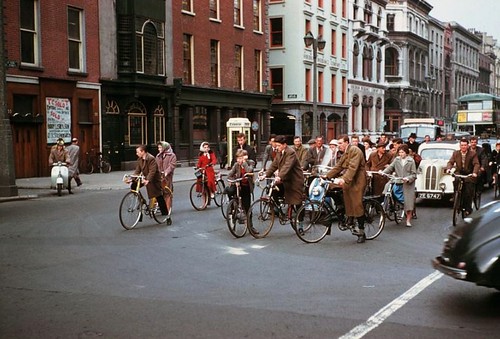
Vehicular cycling in Dublin, 1961. Photo courtesy www.copenhagenize.com (Mikael). A great photo he has used more than once to show how popular cycling used to be in Dublin and how it could be again.

Or in other cities?

Vehicular cycling in Copenhagen, c. 1950s. Photo courtesy www.copenhagenize.com. Even if this is not literally Vehicular Cycling - if the cyclists have some XXXL bike lane - they so dominate the road that any cars would need separated facilities to protect them from the cyclists!

With all due respect, am I missing something here? Why does Mikael use two examples of what is - more or less - vehicular cycling - with a small "v" and a small "c" to show that separated infrastructure is needed?

I feel very safe cycling in Copenhagen and Amsterdam and so on. The authorities, designers, advocates and activists do a great job. I am not arguing for VC in these cities under current conditions (primarily too high speeds). Perhaps the whole frame for this discussion is a little off, so I want to suggest alternative definitions of the two ways bikes and cars are dealt with in cities:

Vehicular Cycling: In its pure sense, this follows a serious underestimation of the subjective and objective danger cyclists feel towards drivers.

Separated infrastructure: While definitely better in encouraging a higher modal share of cycling, it is the result of accepting that heavy, privately-used vehicles traveling at 50 km/h (30 mph) or higher are necessary, or inevitable, in built-up areas.

A few years back - if I remember correctly - many cyclists in Dublin protested the plans for separated infrastructure, and it seems like they lost.

So... is separated infrastructure special bike clothing? Are bike paths helmets? Mikael and many others in the "Cycle Chic" movement have fantastically shown that people can wear whatever they want - or as nice as they want - whilst cycling, but how come this logic does not carry over into how the streets themselves are adorned?

What kind of street do you live on? How is it clothed?

Wednesday, June 16, 2010

"Freedom Muffins!!" - USA government, aided by automobile industry, prepares attack on UK


The U.S. Department of State held a surprise press conference in Detroit late on Tuesday evening to announce that it would launch a pre-emptive strike on the UK on the Fourth of July of this year, the 234th anniversary of the USA's automobile-enabled victorious revolution against British rule.

At the press conference, Secretary of State Hillary Clinton announced that English muffins would now be called "Freedom Muffins" The spokesperson for Google, the owner of You Tube, introduced a short video which it said it would help go viral.

The spokesperson for Chrysler-owned Dodge said that the video would speak for itself.


The USA ambassador to the UK, Louis B. Susman, was summoned to 10 Downing Street. But the ambassador instead went to a T.G.I.Friday's restaurant in London, where he was joined by a large, patriotic crowd of armed "American" expats, who robbed journalists of their equipment, thus ending reporting at the scene.

Sources later reported that the Yankee mob later moved throughout the UK capital, leaving armed men and women at key Italian government entities and businesses, which they pledged to protect, due to Fiat's minority ownership of Chrysler.

(Please also see this related story)

Monday, June 14, 2010

Sailing safer than driving?

Probably many readers know the story about Abby Sutherland, a 17 year old "American" who just got rescued from her boat the "Wild Eyes" in the Indian Ocean. Earlier, she was trying to become the youngest circumnavigator of the planet, but she had some problems earlier near South Africa or something, which somehow disqualified her, but she decided to continue the voyage.

Of course, billions - including sailing experts - are complaining about this, some saying it is child abuse.

So, the first question to ask is how safe are different types of boating? Quite obviously - so obvious that I will not provide a reference link - the two best things to do are to wear a life vest and take classes. However, the unavoidable still happens, so probably the best thing to do is to not mix sailing and war. (Once when I went sailing --- okay at the risk of sounding unadventurous or poor, I will state more accurately: the one time I went sailing was in Long Beach harbour in 1982. At the time the USS New Jersey was being retrofitted there, destined for subsequent service in the Lebanese Civil War.). In other regards, well, think about it, boats have huge permanently-installed airbags in-between them called "water". Boats for the most part do not have brakes -- this also means that they are safer, because if you don't have brakes you don't need them.

On the other hand, cars are relatively much more dangerous, whether you are drinking sea water, milk or caffeinated drinks, and slightly more if you are drinking alcohol.

But comparing boating to driving? Perhaps traveling on the Congo River vs. driving a car (are there equivalent roads?) is possible. If someone can do it, I will make a link to it here.

In the meantime, I will start to end this voyage with a quote by Abby Sutherland's father, taken from the UK Guardian:

"I never questioned my decision in letting her go. In this day and age we get overprotective with our children," Laurence Sunderland said. "Look at how many teenagers die in cars every year. Should we let teenagers drive cars? I think it'd be silly if we didn't."

In closing, while I would support driving age and voting age being the same in USA, I think a great supporting measure would be massive investment in ocean and fresh water boating for transport (and e.g. floating "boat ins" for movies) and not just de-paving of the roads of the world, but their transformation into canals.

Sunday, June 13, 2010

"Unmanned Commercial Flights Could Become A Reality"


Ha ha ha, I sometimes cannot believe the crap they spend our money on.

From PSFK: "The US Federal Aviation Administration is undertaking a research project to explore the possibilities of pilotless commercial flights. The project is part of its NextGen initiative which is aimed at modernizing the country’s flight infrastructure."

At first all lifts had an operator, now almost none do and no one questions it. Driver-less metros have been operating for some time in many places and are said to have improved things by reducing operator errors, but they operate on a track, in two dimensions.

Are there plans for captain-less boats and ships? Or riderless bicycles?

Better might be unmanned, virtual reality flights :-) or at the very least, flying only when there is no convivial land transport option.

While some military investments trickle down into civilian technology (well, often not "civil", per se...), I wonder if this is a kind of trickle-up thing, and The They Corporation wants to use this tech to fly huge bombers long distances. In other words, indirect military budgeting.

Staying on the science fiction theme, 35 years ago the movie Airport '75 showed (taught) us how a justifiably crazed flight attendant could guide a jumbo jet with damaged controls through the Rocky Mountains, with no training, a bad radio connection and a joy stick. More recently, a group of better trained persons were said to have flown several normally-operating commercial airliners into high value targets in the eastern United States.

Image of Karen Black from Cinema de Merde

Friday, June 11, 2010

Se beber, não ande de bibicleta e nem a empurre


From AMOBIKE, this video has two titles: The one above says "Drunk pushing a bicycle" and in the video itself it says "Drunk on the Road."

In scenes like this one of the first things I notice is the reaction of passersby. In this case, first another cyclist seems to have some concern, but perhaps it is only because he notices that this is being recorded.

But after the guy collapsed my strong assumption was that the first car would not stop... and I was happy it did: Perhaps readers could share experiences of the same or opposite... or if as a cyclist they have helped a driver. As always, the videographer's lack of intervention should be questioned.